

Maria Agnesi: Mathematician Magician
Name: Maria Gaetana Agnesi
Born: 16 May 1718
Died: 9 January 1799
Country: Italy
Culture: Milanese, Baroque Italy

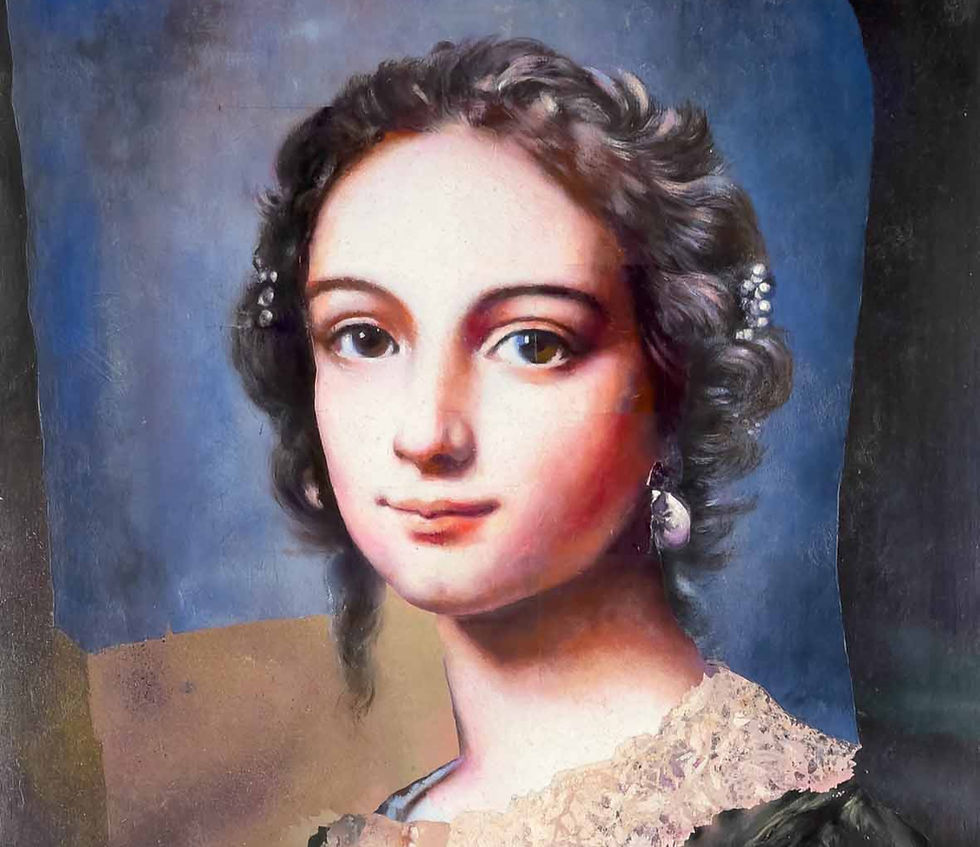
Maria Gaetana Agnesi was born to a wealthy family in Milan, Italy. Her parents sold luxurious silk fabrics that made them rich. They lived near Bologna, a town renowned for its university that attracted academics and scholars from across the world. Maria was the oldest child, and her parents quickly realized that she was different from pretty much all other children. She was a child prodigy.
By the time she was eleven years old she could speak seven languages: Italian, French, Greek, Hebrew, Spanish, German, and Latin. She was smart and outspoken, confident in herself and her thoughts. She recited from memory a Latin oration that denounced the discrimination against women’s education, arguing that women’s minds were worth educating. She argued that girls should have the freedom to pursue the same knowledge that was available to boys. Her intelligence and well-spokenness captured the attention of the wealthy elites in Milan and she got the nickname oracolo settelingue, the “Orator of Seven Languages.”
Maria didn’t get her intellect from nothing. She was studious, learning everything she could from her family’s library on languages, history, literature, science, and mathematics. By the age of fourteen, she had outgrown the basic textbooks and was studying physics and geometry, something hardly any women were allowed to do. In fact, some people thought that she studied too much. When she was twelve Maria was struck with a sudden, mysterious illness. The doctors couldn’t figure it out and attributed her sickness to excessive studying. For her treatment, the doctors recommended that she stop studying and replace her study time with dance practice. Maria refused. She got better.

In Italian culture at the time, smart women were seen as exceptions, curiosities that were hailed as points of civic and familial pride. By the time she was fifteen, Maria’s intellect had become the subject of curiosity from the Milanese nobility. Everyone wanted to meet the young girl with such a brilliant mind. Her father started hosting scholarly soirees in Bologna, inviting the scholars there, some of the best minds in the world at the time, to come and discuss with Maria. In each discussion, Maria would present a thesis, an argument that she supported with evidence, logic, and reason. Then she and the scholars would discuss philosophy, logic, reason, and theory to support or weaken her thesis, or suggest new perspectives. These meetings went on for years, and records of what was discussed were published in books, Lettres sur l'Italie and Propositiones Philosophicae. The latter was published when Maria was nineteen.

Despite the fame that these meetings garnered for Maria and her family, she did not enjoy the attention. Speaking on her experience with these discussions, she said “ I gathered inspiration from discourses with my father’s guests. These people were important experts in their respective fields. I was so blessed to have exchanged ideas with them, regardless of it being at one of my father’s academic gatherings. I never liked being in the limelight, for I always preferred more subtle, quiet ways of going about life.”
Although Italian culture supported some intellect in women, Maria was still expected to set aside her education now that it was time for her to marry. The same year her book was published, Maria put her foot down. She did not want to host these academic soirees anymore, and she refused to be married either. Rather, she wanted to devote herself wholly to the study of mathematics. After some argument, her father agreed. Marie quickly delved into furthering her studies of mathematics, especially differential and integral calculus. She devoted herself entirely to mathematics, and was particularly passionate about finding new ways to teach mathematics to teenagers like herself.
Later in Life
Later in life, Maria would continue to be celebrated as a great mathematician. She was inspired by works written by great thinkers like Isaac Newton. In 1750, she received her diploma from the University of Bologna.


When she was just twenty-nine her passion and education motivated her to publish a whole textbook to help teenagers learn the complicated elements of calculus, mathematical analysis, and algebra. Her textbook, Instituzioni analitiche ad uso della gioventù italiana, (Analytical Institutions for the Use of Italian Youth) was translated into multiple languages and was spread all across Europe. It was hailed widely as one of the great publications of mathematical thought of its time. Empress Maria Theresa, who ruled the massive Austro-Hungarian Empire, sent Maria a diamond ring and a personal letter of gratitude for the work, and Pope Benedict XIV, the leader of the Catholic Church that held power over most of Europe, wrote her his compliments in a letter accompanied by a gold medal. In 1750, when Maria was just thirty-two years old, the Pope appointed her as the Chair of Mathematics and Natural Philosophy at the University of Bologna.
Legacy
In 1996, an asteroid was named in her honor, 16765 Agnesi, and there is a crater on Venus, the Agnesi Crater, named in her honor.


Comments