

The Forbidden Scholar: Cristina Roccati
Born: 24 October 1732
Died: 16 March 1797
Country: Italy
Culture or Era: The Age of Enlightenment

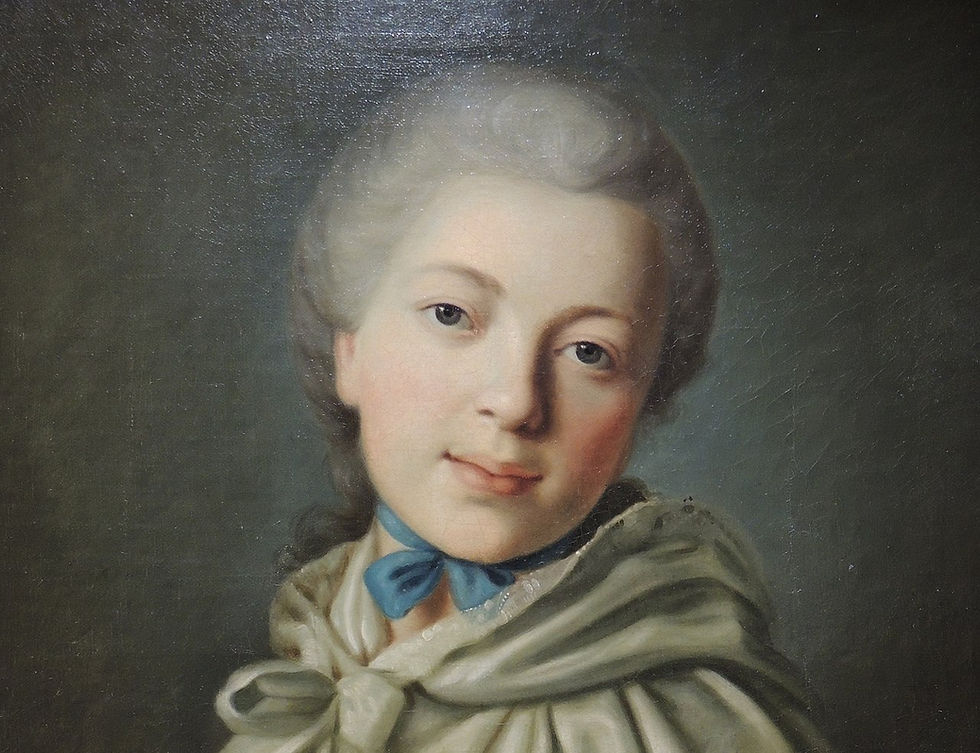
Cristina was great at math. She was a well-known physicist and poet who was the third and youngest woman of her time awarded a university degree in Italy. She was born to a wealthy family in a small town called Rovigo in northern Italy. Like many young women from wealthy families, she was given a private tutor for her education. But unlike most students, by the time she was fifteen she had surpassed her teacher in literature, mathematics, and science. She had an appetite for knowledge and the discipline to continue to seek it out. Christina wanted more.
She approached her father and asked for permission to attend university. The local university in Padua was nearby and would have been ideal, but their school did not accept women. After reluctantly awarding a woman named Elena Piscopia a degree the century before, the university had barred all women from studying there. In fact, most universities did not accept women. Girls from wealthy families were expected to have some education from private tutors that kept them confined to the family’s private libraries or studies. Certainly not a public university, sitting with male students. For a young woman to attend a public university was basically unthinkable.
In 1747, still 15, Cristina applied to study at the University of Bologna and, miraculously, she was granted permission. Christina’s aunt and tutor accompanied her by carriage to the University of Bologna, one of the most respected universities in the world. There, Cristina did the unthinkable: she sat in classes elbow to elbow with male university students. Just her presence there was revolutionary. Even Maria Agnesi, another teen prodigy whose textbook on mathematics was hailed across Europe, did not attend university. At the time, only two other women in the world had received university degrees, both in Italy: Elena Piscopia from the University of Padua in 1678 when she was thirty-two, and Laura Bassi from the University of Bologna in 1732 when she was twenty-one.
Cristina had earned her place in class, but her admission was still a miracle. Many were shocked at the admission of a girl, and one so young, and even those who knew Cristina’s intellect thought it scandalous that a girl would pursue “masculine” subjects like science and math. But Cristina didn’t let them distract her. She could not, under any circumstances, waste the opportunity she had been given.

She threw herself into her studies, and for three years she was immersed in science, physics, geometry, astronomy, logic, and philosophy. She attended lectures, observed physics experiments, attended anatomical sessions, and took notes on everything. She learned about the scientific breakthroughs of Galileo and Isaac Newton’s theories on physics. She also took advantage of her new hometown. A far cry from her rural origins, Bologna’s bustling city life full of scholars let Cristina brush shoulders with the intellectual elite of her time. She attended community lectures and soirees to discuss mathematics and philosophy, and began composing math nerd poetry to the delight of her new scholar friends.

In 1751, after four years, Cristina made history when earned her university degree at just nineteen years old, becoming the third and youngest woman in history to do so. But after graduation, she wasn’t quite sure what to do. A friend offered her a position at the Accademia dei Concordi in Rovigo, her hometown. This was a circle of intellectuals who got together to discuss and move forward new ideas in science, mathematics, and philosophy.
Her joining of the club was met with significant grumbling and even a few dramatic resignations from some of the men who were offended at the idea of a woman joining their circle. But Cristina, no stranger to feeling unwelcome in male-dominated academic spaces, accepted the position. Outside of the club, Cristina also started teaching physics in her hometown, offering night classes for those interested. She expounded on the ideas of Galileo and Newton, bringing the newest and most exciting ideas of the time to the students of her rural hometown.
Later in Life
Three years after her university graduation, Cristina was elected president of the Accademia dei Concordi in Rovigo. She continued teaching in Rovigo for twenty-five years, lecturing at the Tempio della Beata Vergine del Soccorso. Over one thousand pages of her lecture manuscripts survive, covered in her distinctive handwriting. They testify not only to her breadth and depth of knowledge but her dedication and passion to education and teaching.


Legacy
In Rovigo, the Tempio della Beata Vergine del Soccorso, where Cristina lectured for decades, still stands, nicknamed “La Rotunda” for its distinctive octagonal structure. In 2024, an exhibition of her scientific notes was displayed at Palazzo Roncale in her hometown in an exhibition called Cristina Roccati, the woman who “dared” to study physics. The exhibition included her handwritten notes on the solar system, geometric principles, optics, and more. One of the telescopes of the European Space Agency’s (ESA) PLATO project, intended to search for Earth-like planets, bears her name in honor of her contributions to science and astronomy.
“Our tendency is to heroize the scientists who make great discoveries and big inventions,” says Findlen. “But the vast majority of scientific work is not about those eureka moments. It is about the daily life of the gradual, often uneven and halting accrual of knowledge. It is also about teaching and transferring bodies of knowledge from one generation to another.”



Comments