

Vinnie Ream: President Lincoln's Personal Sculptor
Born: September 25, 1847
Died: November 20, 1914
Country: United States
Culture or Era: American Civil War

In the U.S. Capitol building in Washington D.C. stands a tall marble sculpture of Abraham Lincoln, the 16th President of the United States. The statue’s base has two names: Abraham Lincoln and "Vinnie Ream 1870." This second name was the artist whose hands had sculpted the marble statue. The sculptor, Vinnie, was the youngest artist and the first woman to receive an art commission from the U.S. government. She was just 18 when she was awarded the commission, but had been working as a sculptor in the White House for years before then.

The future artist was Lavinia “Vinnie” Ellen Ream, born in a log cabin to a poor family in Madison, Wisconsin. At the time Madison was a frontier town with very few buildings and far from the big cities. Life on the frontier was tough, demanding physical work from everyone in the family. After her chores for the day, Vinnie would read whatever books she could find, and quickly discovered her favorite books were about art. She developed a real passion for paintings and sculpture, and started to dream about being an artist. But because of where she lived, Vinnie had never seen a piece of art in real life, and her family was too poor to send her to art school. But from her childhood, Vinnie learned resilience, dedication, and ambition. In a letter to her mother, Vinnie remarked that
“I feel that I am to have some special work in the world. I don’t know what it is, but I must be ready for it when it comes.”
When she was a teenager, Vinnie’s family moved a few times for her dad’s job—to Kansas, Missouri, and Iowa—before they settled in Washington D.C. when she was 14. The same year that their family moved to D.C., the Civil War broke out, where southern American states broke away from the northern states to form their own Confederacy. Tensions were high and the future of the country was uncertain. Union soldiers filled the streets, defense fortifications were being built, and hospitals were full of wounded soldiers. The U.S. State Capitol Building was still finishing the construction of its dome and the Washington Monument was only one-third finished as available workers left to join the war effort. In D.C., Vinnie helped volunteer at local hospitals for soldiers returning from battle, and collected donations for supplies to help the war effort. Her boundless energy made her a valuable asset to the volunteer efforts.
![Marble statue in front of the rotunda of the Capitol, Washington, [D.C.], 1860, Library of Congress](https://static.wixstatic.com/media/4dde1b_bfc7ec33dcdf4169884010f485546294~mv2.jpg/v1/fill/w_436,h_464,al_c,q_80,enc_avif,quality_auto/4dde1b_bfc7ec33dcdf4169884010f485546294~mv2.jpg)
With so many men away at the battlefield, women stepped up to keep the city running. At 15 years old Vinnie became one of the first and youngest women employed by the US federal government when she started working at the federal post office. She was paid $50 a month. After her shift, Vinnie spent her free time wandering the halls and admiring the art there, especially the sculptures.
A local Congressman, a man named James Rollins, noticed the young woman he passed in the halls who had such a passion for art. One day, Congressman Rollins invited Vinnie to join him on a visit to the studio of Clark Mills, one of the best sculptors in the country. When they arrived the artist was working on a clay model of a sculpture and, upon seeing the artist’s work, Vinnie spontaneously blurted out “I could do that!” Mills paused his sculpting to grab a small bucket of clay. Handing it to her, he encouraged her to “see what she could make.”
Surprised, Vinnie grabbed the clay and, after a moment’s contemplation, carefully sculpted a portrait of a Native American man that she remembered from her childhood in Wisconsin. Mills was so impressed with Vinnie’s talent that he invited her to join his art studio as an assistant. She gladly accepted. This was it—her dreams were coming true. She kept her job at the post office (her family needed the money) but after work she spent all her time at the studio.
With a bit of mentorship, Vinnie’s talent and confidence blossomed. She started by practicing with clay, mimicking her mentor’s techniques, before graduating to small blocks of marble. Word spread about the young female sculptor and her work was often interrupted by curious bystanders coming to visit her studio. She was quite the sight: standing less than five feet tall with dark curls cascading down her back, she fastened aprons over her poofy skirts and chiseled with tools too large for her hands. The capitol was enraptured by the little female sculptor. After just one year, Vinnie’s sculptures started to be in high demand. She started to make medallion-sized portraits of local politicians. Soon enough, she was getting commissioned from local politicians for full marble portraits.

Vinnie was making quite the name for herself. Soon enough she was making enough money from sculpting that she quit her job at the post office and devoted herself full-time to her art. She was doing it—she was living her childhood dream of being an artist. But her dreams would only grow bigger. Vinnie often saw President Lincoln’s carriage on the streets of D.C., and tried a few times to sculpt his portrait from memory but never quite succeeded. Vinnie was confident, bold, and ambitious. She decided that one day she would sculpt the president.
Vinnie asked Congressman Rollins to see if there was any way she could sculpt the president while he worked at his desk. She promised to be “as quiet as a mouse.” President Lincoln was a busy man, and was hesitant to have someone in his office. But when he learned about Vinnie's background, being from a poor frontier family and having such a talent for art, he felt a kinship with her. He too had been born to a poor family in a log cabin in a frontier town, and worked his way up in Washington D.C. The president agreed to sit for the young artist. Vinnie recalled,
“He had been painted and modeled before, but when he learned that I was poor, he granted me the sittings for no other purpose than that I was a poor girl. Had I been the greatest sculptor in the world, I am sure he would have refused at the time.”
For the next five months, Vinnie spent thirty minutes every day in President Lincoln’s office, sculpting the president while he worked. But true to her word, Vinnie was silent and diligent in her work. Working in close proximity, she grew to greatly admire Lincoln. She remarked how he would sit...
“with his great form slouched down into a chair at his desk, his head bowed upon his chest, deeply thoughtful. I think he was with his generals on the battlefields, appraising the horrible sacrifices brought upon his people and the nation... Sometimes great tears rolled down his cheeks…”
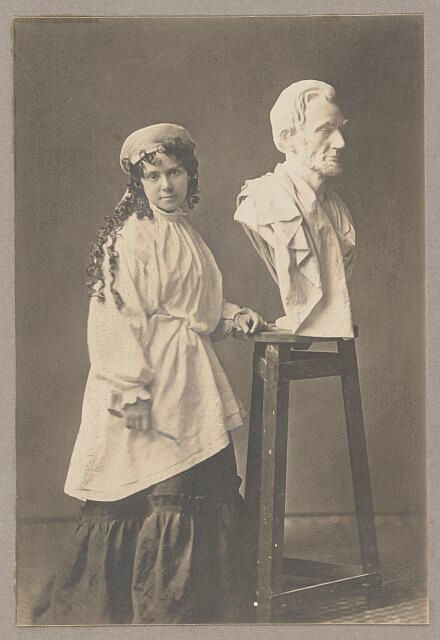
After months of work, Vinnie was nearly finished with the model. On April 15, 1865, Vinnie had her morning sculpture appointment in the Oval Office like normal. That evening, while with her family for supper, Vinnie heard shouting in the streets: President Lincoln had been assassinated. When she heard the news, she was overcome with grief.

The tragic passing of the President only spurred her further. Vinnie was determined to do the president justice in his sculpture. She finished the bust, a spectacular and realistic portrayal of the now-late president. Finishing the project was bittersweet. Her sculpture showed a personal and psychological portrait of a complicated man. Speaking about Lincoln, Vinnie remarked,
“I think that history is particularly correct in writing about Abraham Lincoln to describe him as a man of unfathomable sorrow. That was the lasting impression I always had of him. It was this that I put into my statue, for when he sat for me he let himself go and fell into the mood that was ever with him, but against which he struggled.”
The following year, a competition was announced to select an artist who would sculpt the president’s official statue for the U.S. Capitol. Dozens of high-profile, established sculptors entered the competition, and Vinnie submitted her clay bust she had spent so many months on. Shockwaves rolled through D.C. when it was declared that Vinnie Ream, now eighteen years old, was selected. Many people argued against the decision, saying Vinnie was too young, too inexperienced, or too female for such an important work. One senator bemoaned that commissioning a female artist would result in “a complete failure in the execution of this work.”

...this candidate is not competent to produce the work... She cannot do it... She may make a statue [but] she cannot make one that you will be justified in placing in the national capitol... Surely this edifice, so beautiful and interesting, should not be opened to the rude experiment of untried talent. Only the finished artist should be admitted here."
Opposition to Vinnie Ream's selection in the Springfield Weekly Republican, August 25, 1866


Regardless of the immense pushback, not just in D.C. but across the country, she became the youngest artist and the first woman to be officially commissioned by the U.S. government.
![Public resolution announcing the awarded commission to Vinnie Ream, Daily National Intelligencer, Washington City [D.C.], September 6, 1866](https://static.wixstatic.com/media/4dde1b_5a0c73a79dd5498fb773b25a337d3142~mv2.png/v1/fill/w_980,h_471,al_c,q_90,usm_0.66_1.00_0.01,enc_avif,quality_auto/4dde1b_5a0c73a79dd5498fb773b25a337d3142~mv2.png)
Vinnie didn't pay them any mind, and her win made her instantly famous. Prominent American leaders came from all over to visit her studio, including General Ulysses S. Grant and suffragette Elizabeth Cady Stanton. But Vinnie refused to let fame go to her head. She rolled up her sleeves and she got to work. She decided that her sculpture would be made of marble, and not just any marble. Using the $10,000 winnings that came with the commission, she flew to Italy and selected marble from a quarry in Carrara, the very same marble quarry that famed Renaissance artist Michelangelo used in his sculptures.

She spent a couple of years in Italy, sculpting and overseeing a studio of assistants until it was just right. It was fashionable at the time for presidential portraits to show the leaders in a Roman toga or military uniform, but Vinnie wanted to show the man as she remembered him: in his own clothes, standing tall and a little weary, bearing the burden of a fracturing nation on his shoulders. She focused on making the statue perfect, to honor the president she had spent so much time with.
In 1871, when she was 23, a crowd gathered under the glittering dome of the U.S. Capitol rotunda as the statue, draped in a silk American flag, was unveiled to great applause. Vinnie, overcome with the magnitude of the moment, quietly wept. To this day, the statue stands under the Capitol’s rotunda, a silent and unbending witness not only the president’s legacy, but Vinnie’s as well.
Vinnie later married and became Vinnie Ream Hoxie, and though social conventions at the time forbade her from continuing her work as an artist once married, she eventually returned to it later in life. She became well known in creative circles, being friends with artists, authors, poets, designers, and more, including Walt Whitman who wrote the below note asking to meet her in 1874:

Three of her works remain on display around Washington D.C., and the city Vinita in Oklahoma is named in her honor. Her incredible story inspired suffragette Elizabeth Cady Stanton in her speeches about women's equality (below). And in 2009, Ream was honored as part of a special Bicameral Celebration of Abraham Lincoln’s 200th Birthday at the US. Capitol, where speakers including President Barack Obama praised Vinnie and her work.
![Elizabeth Cady Stanton's handwritten speech "Our Young Girls" with a note of "Vinnie Ream" on the sixth line of the second page, after the following passage: "but the girl who earns her bread, or makes for herself a name has all the boy has to surmount and these artificial barriers of law & custom in addition." Elizabeth Cady Stanton Papers: Speeches and Writings, 1848-1902; Speeches; [1872]; “Our Young Girls”, Library of Congress](https://static.wixstatic.com/media/4dde1b_9c25d6a044594db08fef759651f4aa17~mv2.jpg/v1/fill/w_980,h_615,al_c,q_85,usm_0.66_1.00_0.01,enc_avif,quality_auto/4dde1b_9c25d6a044594db08fef759651f4aa17~mv2.jpg)


Comments