

Elizabeth Barrett Browning: Victorian Poet
Updated: Jun 5
Born: c. 6 March 1806
Died: 29 June 1861
Country: England
Culture: Victorian Era

This teenage poet inspired both Emily Dickinson and Virginia Wolf. Elizabeth Barret was one of the most celebrated poets of England’s Victorian era, whose works were published throughout Europe and the United States, and continued to be published even after her lifetime.
Elizabeth was the oldest of twelve children, with eight brothers and three sisters. Each child had a nickname, and Elizabeth’s childhood nickname was “Ba”. Her family was pretty wealthy, and Elizabeth grew up on a 500-acre estate called Hope End.
The estate was a dreamland for Elizabeth. Its rolling grounds were dotted with farmer’s cottages, copses of trees, ponds, carriage roads, and of course the large mansion where she lived. With her family, Elizabeth enjoyed all of the fun hobbies of wealthy English families: she rode ponies around the country lanes, joined her siblings for picnics in the hills, visited other country families for afternoon tea, and when the weather was disagreeable, staged homemade theatrical plays with her siblings for her parents. But even with all the lavish distractions in the world, Elizabeth could not keep her mind off of her books. As she later wrote about her adolescence,
“Books and dreams were what I lived in and domestic life only seemed to buzz gently around, like bees about the grass.”
The estate had a library, and Elizabeth spent more time than anyone else in her family within its walls, reading its many stories. By age six she was reading novels, and by the time she was eight she started reading translations of the great Greek poet Homer. She spoke English and French, and her reading inspired her to study Greek and Latin on her own when she was ten years old, and when she was 11 she composed her first epic poem The Battle of Marathon, inspired by Homer. She devoured books on the histories of England, Greece, and Rome, as well as several of Shakespeare's plays like Othello and The Tempest. She continued to teach herself Greek and Latin, and added Hebrew and Italian to the list as well.

A few years later when she was fourteen, her dad paid to publish The Battle of Marathon in a bound book, her first work as a poetess. To this day, published copies of this work are highly desired by collectors as only fifty copies were printed.
Thankfully, Elizabeth’s parents were supportive of her writings. Her mother collected her daughter’s early poetry into a book called “Poems by Elizabeth B. Barrett”, and her father called her the “Poet Laureate of Hope End”. They both encouraged her to keep honing her skills. Because of this support, Elizabeth kept writing and to this day her collected poems make up one of the largest collections of a poet’s teenage works (called juvenalia) in the world.
When she was 15, Elizabeth read an essay, A Vindication of the Rights of Woman, written by Mary Shelley’s mother, Mary Wollstonecraft. Elizabeth became a passionate supporter of women’s rights.
While she kept up her writing, as a teenager Elizabeth also started to battle against a mysterious illness that even the best doctors couldn’t diagnose. She had intense pain in her head and back that would come and go, and when it got really bad she couldn’t even move. While some doctors hoped that the symptoms would just fade with time, it didn’t. This mysterious ailment, and the medicine that treated it, would remain a part of Elizabeth’s daily battle for the rest of her life.
At age 19 she anonymously published a volume of her works, An Essay on Mind, with Other Poems. She was really nervous about publishing, and even more nervous about the response if anyone found out she was a woman, and young to boot. In the preface, she anticipates what criticism she may receive:
“the imputation of presumption is likely to be attached to me, on account of the form and title of this production”

While the publication did not make a huge splash, it was generally pretty well received, and soon after Elizabeth after struck up a few friendships that solidified her in the realm of scholars, thinkers, and writers of her day. She continued her first love, reading, and especially loved classical Greek literature: anything from Homer, Plato, or Aristotle.
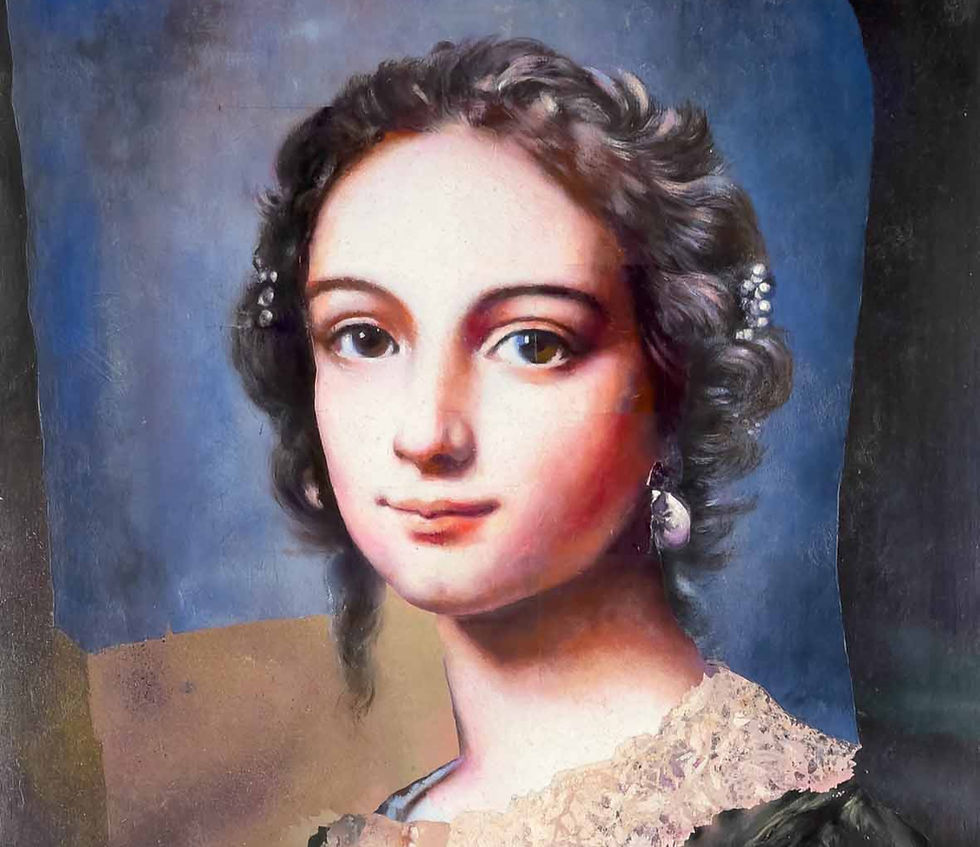
A fellow female writer of the time, Mary Russel Mitford, described Elizabeth as having "a slight, delicate figure, with a shower of dark curls falling on each side of a most expressive face; large, tender eyes, richly fringed by dark eyelashes, and a smile like a sunbeam."
Later in Life
Although her mysterious illness kept her sick for much of her life, Elizabeth continued her writing. She decorated her home with portraits of great poets like Homer, Chaucer, Tennyson, and Wordsworth. After her family suddenly lost all their wealth and had to sell their estate, Elizabeth was saved from a life of poverty by an aunt and uncle who left her an independent inheritance. This inheritance made it so that Elizabeth could afford to live without being married if she wished. It wasn’t until 1838, when Elizabeth was 32, that she published her first book under her own name to the public: The Seraphim and Other Poems, which she called “the first utterance of my own individuality.” She continued to publish many works after this, many of which went on to be critically acclaimed and published throughout Europe and the United States. When the most famous English poet of her time, William Wadsworth, died in 1850, Elizabeth was considered to replace him as the nation’s poet laureate, considered alongside celebrated poet Lord Tennyson.
One of her volumes found its way into the hands of another poet, Robert Browning, a poet Elizabeth herself admired. Robert wrote to her, saying “I love your verses with all my heart, dear Miss Barrett.” The two started writing letters back and forth, and soon fell terribly in love. They fell into a secret relationship (Elizabeth’s father was a control freak and didn’t want his daughter relying on another man). In their love letters is found perhaps Elizabeth’s most famous line:
“How do I love thee? Let me count the ways."
The two married, moved to Italy, had a son, and Elizabeth continued to write on important topics, supported by her husband, throughout her life, publishing her most celebrated work, Aurora Leigh, when she was 51.


Her writings fought for social justice, advocated for the end slavery in America, criticized child labor used in England’s mines and mills, and railed against the forced restrictions placed upon women in the 19th century. Her family wealth and the lavish estate she had adored as a child was funded by exploitative plantations in Jamaica that her parents owned, exploiting enslaved people’s labor for profit. As Elizabeth continued to read and learn, she became a staunch abolitionist, calling for an end to the slave trade.
At age 55, Elizabeth passed on June 29, 1861, held in the arms of her beloved husband. Journals across Europe and the United States announced her tragic passing, many calling her the greatest woman poet in English literature. The Edinburgh Review cried,
“Such a combination of the finest genius and the choicest results of cultivation and wide-ranging studies has never been seen before in any woman”
and Southern Literary Messenger called her “the Shakespeare among her sex,” declaring her among the five greatest authors of all time. She is buried in the English Cemetery in Florence, Italy.

Legacy
Another young female poet named Emily Dickinson would keep a framed portrait of Elizabeth Barret, who she greatly admired, in her bedroom. Unfortunately, in the decades that followed Elizabeth’s poetry, while hailed in its time, was quietly left in the past, and poetry curriculums stopped teaching her works. It wasn’t until nearly a century later that another famous female author, Virginia Wolf, published an essay advocating for greater study of Elizabeth’s works. Wolf wrote, “Elizabeth Barrett was inspired by a flash of true genius”, and declared
“with her passionate interest in social questions, her conflict as artist and woman, her longing for knowledge and freedom, is the true daughter of her age."


Comments